

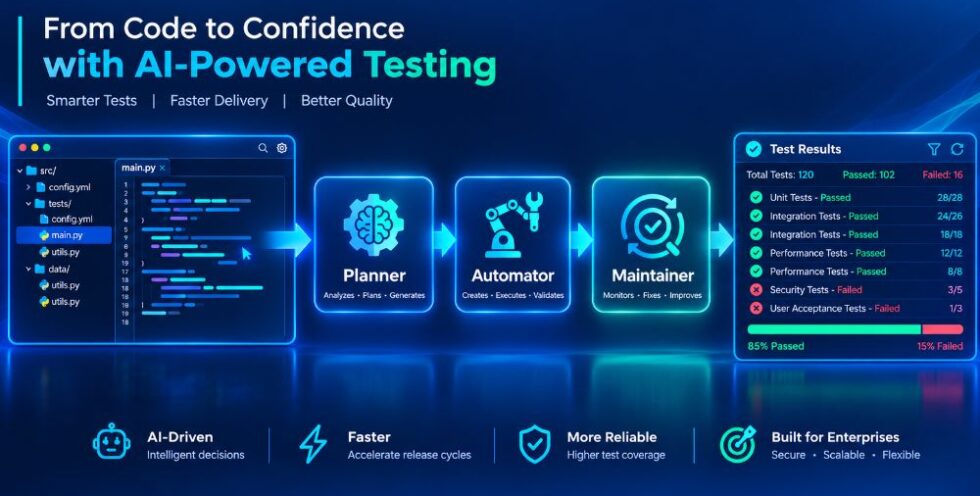
Choosing an AI testing platform is an important decision for enterprise QA and engineering teams. The right solution may help teams improve test creation, automate repetitive workflows, investigate failures, and manage software quality more efficiently. The wrong choice can introduce integration complexity, unexpected costs, unreliable tests, and additional maintenance work.
With vendors offering different combinations of artificial intelligence, test automation, analytics, and self-healing capabilities, comparing platforms can quickly become confusing. Marketing claims alone are not enough to determine whether a solution will work in your environment.
This guide explains how to evaluate an AI testing platform using practical criteria, measurable business outcomes, security requirements, and a structured proof of concept.
What you will learn
- Which AI testing platform capabilities to assess
- How to evaluate automation coverage and AI accuracy
- What to check for integration, security, and governance
- How to compare platform costs and potential ROI
- How to run an enterprise proof of concept
- How to score vendors using a practical evaluation framework
What Is an AI Testing Platform?
An AI testing platform is a software solution that uses artificial intelligence or machine learning to assist one or more activities in software testing. Depending on the product, this may include generating test scenarios, supporting test automation, analyzing failures, recommending test priorities, or helping maintain automated tests.
Not every product provides the same capabilities. Some focus on a specific testing activity, while others bring several capabilities together in a broader platform. Enterprises should assess what is actually available, how each capability works, and whether it solves a defined problem.
An AI testing platform should be evaluated as part of your overall quality engineering workflow—not as an isolated product.
Why Enterprises Need a Structured Evaluation Process
Enterprise testing environments often involve multiple applications, teams, frameworks, data sources, release pipelines, and compliance requirements. A platform that works well for a small demonstration may not perform as expected across a large production environment.
Common evaluation challenges include:
- Unclear differences between AI-assisted features and conventional automation.
- Unverified claims about self-healing, autonomous testing, or test generation.
- Limited compatibility with existing applications and testing frameworks.
- Uncertainty about how sensitive code, credentials, and test data are handled.
- Unpredictable licensing, usage, integration, and maintenance costs.
- Difficulty proving whether the platform improves real engineering outcomes.
A structured evaluation makes vendor comparisons more objective and helps teams avoid buying capabilities they do not need.
10 Criteria for Evaluating an AI Testing Platform
1. AI Capabilities and Their Practical Value
Start by identifying which AI capabilities the platform actually provides. Possible capabilities include test-case generation, automation assistance, failure analysis, test prioritization, and support for maintaining tests after application changes.
Ask the vendor:
- Which capabilities are available today, and which are on the roadmap?
- What inputs does the AI require to produce useful results?
- Can engineers inspect and validate generated tests and recommendations?
- How does the platform handle incorrect suggestions or uncertain results?
- Which tasks still require manual configuration or engineering work?
What to measure: Useful output rate, review effort, time saved on the target task, and the accuracy of recommendations against known examples.
2. Application and Technology Coverage
An AI testing platform must support the technologies your teams actually use. Depending on your environment, that may include web applications, mobile applications, APIs, desktop applications, enterprise systems, and different browsers or operating systems.
Do not assume broad compatibility from a vendor’s general statement that it supports enterprise testing. Confirm support for your specific application architecture, test environments, authentication methods, and workflows.
Ask the vendor:
- Which application types and technologies are supported?
- Are there limitations for dynamic interfaces or complex workflows?
- Can the platform work with existing test suites?
- Which browsers, devices, environments, and APIs are supported?
- Are any required features dependent on specific editions or add-ons?
3. Test Creation, Maintenance, and Reliability
Test generation is useful only when the resulting tests are relevant, maintainable, and capable of detecting meaningful defects. Similarly, a self-healing capability should preserve the purpose of the original test rather than merely prevent a failure from appearing.
Evaluate how the platform handles changing application elements, test data, assertions, failed executions, and changes in business requirements.
What to measure: Test creation time, maintenance effort, flaky-test rate, false-positive rate, false-negative rate where measurable, and the percentage of generated tests accepted after review.
4. Integration With Your Existing Ecosystem
Enterprise teams rarely replace every testing tool at once. An AI testing platform should fit into the existing software delivery process wherever possible.
Review integration with:
- Source-code repositories and version control.
- CI/CD systems and build pipelines.
- Test management and issue-tracking tools.
- Collaboration, reporting, and analytics systems.
- Identity management and access-control systems.
Ask which integrations are native, which require APIs or custom development, and whether integrations have additional costs. Confirm that test results and supporting evidence can be exported or retained in an appropriate format.
5. Security, Privacy, and Compliance
AI testing can involve source code, credentials, application logs, customer-related test data, and information about internal systems. Enterprise buyers must understand how this information is processed and protected.
Ask for clear answers about:
- Data storage locations, processing regions, and retention policies.
- Whether customer data is used to train shared or vendor models.
- Encryption, access controls, audit logs, and identity integration.
- Secret management and handling of credentials.
- Available security certifications and relevant compliance documentation.
- Options for private deployment or restricted network environments, if required.
- How the vendor handles security incidents and vulnerability reports.
Validate the answers with your security, legal, privacy, and procurement teams. Do not treat a general compliance claim as proof that the platform meets your organization’s specific obligations.
6. Scalability and Performance
A successful pilot with a handful of tests does not prove that a platform will support thousands of tests, concurrent executions, multiple teams, or demanding release schedules.
Evaluate:
- Parallel execution and concurrency limits.
- Execution times under realistic workloads.
- Support for multiple projects, teams, and environments.
- Queueing, capacity management, and execution reliability.
- Reporting performance and availability commitments.
- Infrastructure requirements and additional scaling costs.
Run representative workloads rather than relying only on vendor demonstrations. Measure end-to-end execution time, including setup, queues, retries, and result analysis where relevant.
7. Reporting, Explainability, and Auditability
Engineering teams need to understand what happened during a test, why a failure was reported, and what evidence supports an AI-generated recommendation.
Assess whether the platform provides readable execution logs, screenshots or other evidence where applicable, test history, traceability, failure categorization, and access to supporting results.
For AI-generated actions or recommendations, determine whether engineers can review, approve, reject, and audit important changes. High-impact decisions should not depend on unexplained AI output.
8. Usability, Skills, and Team Adoption
A technically capable platform can still fail to deliver value if teams find it difficult to use or must significantly change their workflows.
Evaluate the learning curve for manual testers, automation engineers, developers, and test leads. Determine whether the platform requires scripting, specialized AI knowledge, custom framework development, or vendor support for routine tasks.
Use representative team members during the proof of concept. Measure how long it takes them to complete real tasks, troubleshoot failures, and understand the generated output.
9. Total Cost of Ownership
Subscription price is only one part of the cost of an AI testing platform. The total cost of ownership may include implementation, usage charges, infrastructure, integration, training, governance, support, and ongoing maintenance.
Request a clear breakdown of:
- Licensing and user-based or consumption-based charges.
- Execution limits, concurrency, and overage costs.
- Implementation and integration services.
- Required infrastructure and additional software.
- Support plans, training, and renewal terms.
- Data retention, export, migration, and exit costs.
Compare the full cost with the current testing process and the measured results of the pilot. Avoid assuming that time saved automatically becomes a financial saving.
10. Vendor Support, Roadmap, and Long-Term Fit
Enterprise buyers should also assess whether the vendor can support the organization over time. Consider onboarding, technical support, documentation, incident communication, product updates, and the roadmap for capabilities that matter to your team.
Ask how customer issues are escalated, how breaking changes are communicated, what service commitments apply, and how you can export your tests and results if you later change platforms.
AI Testing Platform Evaluation Scorecard
Use the following scorecard to compare shortlisted vendors consistently. Score each criterion from 1 to 5 based on evidence from documentation, demonstrations, technical reviews, and your proof of concept.
| Evaluation criterion | Suggested weight | Evidence to collect |
|---|---|---|
| AI capabilities and accuracy | 15% | Validated test output and measured review effort |
| Application coverage | 12% | Successful execution on representative systems |
| Reliability and maintenance | 12% | Flaky tests, maintenance effort, failure accuracy |
| Integration | 10% | Working integrations and implementation effort |
| Security and governance | 15% | Security review, data policies, auditability |
| Scalability and performance | 10% | Results from representative workload tests |
| Usability and adoption | 8% | Task completion time and user feedback |
| Total cost of ownership | 10% | Full pricing model and pilot economics |
| Support and long-term fit | 8% | Support terms, roadmap, portability |
Scoring method: Weighted score = sum of (criterion rating ÷ 5 × criterion weight). The final result is a score out of 100.
These weights are an illustrative starting point, not an industry standard. Adjust them to reflect your organization’s security, compliance, technical, and business priorities. A high total score should not override a mandatory security or compatibility failure.
How to Run an Enterprise Proof of Concept
A proof of concept (PoC) allows your team to test a platform against actual workflows before committing to a wider deployment.
Step 1: Define the use case
Choose a specific problem, such as reducing test maintenance, improving regression feedback, or accelerating failure analysis. Define measurable success criteria before the trial begins.
Step 2: Establish a baseline
Record current effort, execution time, test stability, failure investigation time, and relevant quality outcomes. Use the same workload when comparing the candidate platform with the existing approach.
Step 3: Select representative scenarios
Include normal workflows, edge cases, known failures, application changes, and relevant integration points. Avoid testing only the easiest scenarios or those selected by the vendor.
Step 4: Validate security and integration
Confirm that the platform meets security requirements and can operate within your approved environment. Test the integrations that would be required for real adoption.
Step 5: Measure results
Compare test quality, human review effort, maintenance, execution, failure analysis, and cost. Record failures and limitations instead of excluding inconvenient results.
Step 6: Make a documented decision
Summarize the evidence, outstanding risks, implementation effort, expected costs, and proposed next steps. Proceed only when the results justify the investment and mandatory requirements are satisfied.
Common Mistakes to Avoid When Choosing an AI Testing Platform
- Choosing based on AI branding: Evaluate demonstrated capabilities rather than product terminology.
- Trusting demonstrations alone: Test your own applications and representative failure scenarios.
- Ignoring existing investments: Determine whether the platform complements or unnecessarily duplicates your current tools.
- Overlooking data governance: Involve security, privacy, and legal teams early.
- Measuring test quantity instead of quality: Assess relevance, assertions, defect detection, and reliability.
- Ignoring hidden costs: Include implementation, usage, review, support, and exit costs.
- Skipping a baseline: Without comparable measurements, ROI claims are difficult to validate.
- Scaling before validation: Start with a focused pilot and expand only when the results support it.
How KZen Tech Approaches AI Test Automation
KZen Tech works with AlgoShack as a sales partner for AlgoQA Agent, an AI-powered test automation solution. Enterprises evaluating the solution should verify its current documented capabilities, supported technologies, integrations, security controls, and commercial terms against their specific requirements.
The goal is not to select a platform simply because it uses AI. It is to identify a solution that addresses a real testing challenge, fits the existing engineering ecosystem, and demonstrates measurable value through a structured evaluation.
Explore the AlgoQA Agent overview or visit KZen Tech to discuss your organization’s test automation requirements.
Frequently Asked Questions About AI Testing Platforms
What should enterprises look for in an AI testing platform?
Evaluate AI capabilities, supported applications, test reliability, integrations, security, scalability, reporting, usability, total cost of ownership, and vendor support. Validate important requirements through a proof of concept.
How do you compare AI testing platforms?
Define mandatory requirements, apply weighted evaluation criteria, test the same representative scenarios across shortlisted platforms, document the evidence, and compare quality outcomes, implementation effort, security, and full costs.
Can an AI testing platform integrate with existing automation tools?
Some platforms offer integrations with existing frameworks, repositories, CI/CD systems, and test management tools. Actual support varies by product, so verify compatibility and implementation requirements for your environment.
How can enterprises evaluate the ROI of an AI testing platform?
Compare measured changes in test creation and maintenance effort, execution time, failure analysis, defect outcomes, and reliability against the full costs of licensing, integration, infrastructure, review, and support.
Why is a proof of concept important?
A proof of concept tests whether the platform works with real applications and workflows. It helps validate capabilities, reveal limitations, assess integration effort, and establish evidence before a larger investment.
What security questions should buyers ask?
Ask about data processing and storage, retention, model training, encryption, access controls, audit logs, credential handling, deployment options, incident response, and the security documentation relevant to your organization.
Does an AI testing platform eliminate the need for QA engineers?
No. AI may assist specific testing tasks, but teams still need engineering judgment, requirements validation, risk analysis, exploratory testing, and oversight of test results and release decisions.
How long should an enterprise AI testing PoC take?
The duration depends on application complexity, integration requirements, security reviews, and test scope. Define the timeline around representative scenarios and measurable acceptance criteria rather than choosing an arbitrary duration.
Ready to Evaluate AI Test Automation?
Identify your testing priorities, assess the available capabilities, and validate the solution against your real-world requirements. KZen Tech can help your team explore the AlgoQA Agent solution as part of its evaluation process.
Evaluation criteria and score weights are illustrative and should be adapted to each organization’s needs. Verify product capabilities, security documentation, and commercial terms directly before making a purchasing decision.