
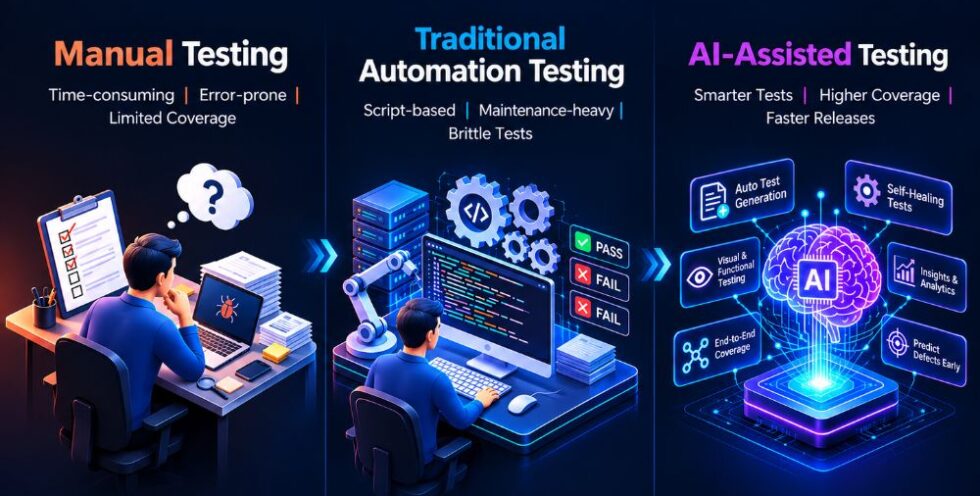
Traditional test automation has helped software teams improve repeatability, accelerate regression testing, and reduce manual effort for years. Now, AI-powered test automation is introducing new ways to generate test scenarios, analyze failures, adapt to application changes, and support testing decisions.
For enterprise QA leaders, the question is not simply whether AI is better than traditional automation. The real question is which approach fits the application’s complexity, testing objectives, existing tools, risk profile, and budget.
In this guide, we compare AI test automation vs. traditional test automation, explain the differences, examine their limitations, and outline how organizations can choose a practical approach.
What you will learn
- What traditional and AI-powered test automation mean
- The key differences in test creation, maintenance, and analysis
- Benefits and limitations of both approaches
- How cost, risk, and application complexity affect the decision
- When to use traditional automation, AI automation, or a hybrid model
- How to evaluate an AI test automation solution for enterprise use
What Is Traditional Test Automation?
Traditional test automation uses predefined scripts, rules, assertions, and test data to verify that software behaves as expected. These tests are commonly developed using automation frameworks and integrated into continuous integration and continuous delivery (CI/CD) pipelines.
For example, an automated checkout test may open a shopping website, sign in with test credentials, add an item to the cart, complete a checkout flow, and verify the order confirmation.
The test follows programmed instructions and checks predefined expected results. When the application changes, the test may need to be updated by an engineer.
Common characteristics of traditional automation
- Script-driven execution: Tests follow explicitly defined instructions.
- Deterministic assertions: Expected outcomes are specified by the test author.
- Repeatability: The same test can be executed consistently under comparable conditions.
- Framework-based workflows: Teams often use established tools, libraries, and CI/CD integrations.
- Human-led maintenance: Engineers diagnose and update tests when application behavior or interfaces change.
Traditional automation remains valuable when workflows are stable, expected results are clear, and teams need precise, repeatable validation.
What Is AI Test Automation?
AI test automation applies artificial intelligence or machine learning to selected parts of the software testing process. Depending on the solution, these capabilities may help generate candidate test cases, assist with script creation, analyze failures, identify patterns, or adapt automation to certain application changes.
Some products use AI for a specific task, while others combine several AI-assisted capabilities in a broader testing workflow. The term “AI-powered” does not mean that every part of testing is autonomous or that human review is unnecessary.
Common AI-assisted testing capabilities
- Test generation: Suggesting test scenarios from requirements, user stories, or application context.
- Automation assistance: Helping create, explain, or maintain test scripts.
- Change analysis: Identifying possible impacts of application changes.
- Failure analysis: Summarizing logs and suggesting potential causes of failed tests.
- Test prioritization: Recommending which tests to run first based on available risk signals.
- Adaptive interactions: Helping automation handle certain interface changes when the product supports that capability.
These capabilities vary significantly between vendors. Enterprises should verify each capability through documentation and a practical proof of concept rather than relying on marketing terminology alone.
AI Test Automation vs. Traditional Test Automation: Key Differences
| Comparison area | Traditional automation | AI-powered automation |
|---|---|---|
| Test creation | Typically authored manually using scripts, frameworks, and defined rules. | May generate or suggest candidate tests using requirements or application context. |
| Execution | Executes predefined instructions and assertions. | May combine conventional execution with AI-assisted steps or decisions. |
| Maintenance | Changes may require manual updates to scripts, selectors, or test data. | Some tools can suggest or support updates when application elements change. |
| Failure analysis | Often relies on logs, debugging, and engineer investigation. | May summarize logs, group failures, and suggest likely causes. |
| Test selection | Often based on predefined suites, tags, and rules. | May recommend prioritization using changes, history, and risk signals. |
| Predictability | Explicit scripts and assertions can make behavior easier to inspect. | AI-generated recommendations may need additional review and validation. |
| Initial investment | Depends on framework development, scripting skills, and infrastructure. | May include licensing, integration, governance, and AI-specific evaluation costs. |
| Best fit | Stable workflows requiring precise, repeatable checks. | Workflows where AI assistance addresses a measured testing challenge. |
The key distinction is not that traditional automation is always manual or that AI automation is fully autonomous. Both approaches can be automated, and many AI-powered products still rely on conventional scripts, assertions, and testing frameworks.
1. Test Creation: Manual Scripting vs. AI Assistance
In traditional automation, QA engineers usually translate requirements into test steps, write scripts, define test data, and specify expected outcomes. This gives teams control but can take considerable effort for large applications.
AI-assisted tools may help draft test cases from requirements, suggest edge cases, or generate initial scripts. Engineers still need to verify that the generated tests represent real business rules and produce meaningful assertions.
Enterprise takeaway: Evaluate how much review and rework AI-generated tests require—not just how quickly they are created.
2. Test Maintenance: Fixed Scripts vs. Assisted Adaptation
Traditional tests may become fragile when interfaces, identifiers, workflows, or test data change. Engineers need to determine whether the test failed because of a genuine defect or because the automation itself is outdated.
Some AI-enabled tools can recognize interface elements, suggest selector changes, or help maintain automation after application updates. Results depend on the technology and the nature of the change.
Self-healing features should be evaluated carefully. An automation tool must not silently change a test’s meaning, weaken an assertion, or hide a genuine application defect just to keep a test passing.
3. Failure Analysis: Debugging vs. AI-Assisted Investigation
Traditional automation provides test results, logs, screenshots, and other evidence that engineers use to investigate failures. This process can become time-consuming when many tests fail for the same underlying reason.
AI-assisted analysis may summarize failure evidence, identify recurring patterns, or suggest potential root causes. These suggestions can speed up investigation, but they are not proof of the cause.
Teams should measure whether the tool reduces investigation time while preserving diagnostic accuracy.
4. Regression Testing: Fixed Suites vs. Risk-Informed Prioritization
Traditional regression suites are often selected through predefined test groups, tags, and execution rules. These practices can be reliable and straightforward to audit, but running large suites may require substantial time and infrastructure.
AI-assisted approaches may use change information, dependencies, historical test results, and other signals to recommend which tests should run first. This can help teams focus attention on higher-risk areas.
Prioritization must not create unacceptable coverage gaps. Critical business flows and compliance-related scenarios should remain protected by explicit testing requirements.
Read our guide to AI test automation for regression testing.
5. Cost Comparison: Look Beyond Licensing
It is tempting to compare traditional and AI test automation by looking only at software subscription prices. A meaningful comparison includes the full cost of building, operating, maintaining, and governing the testing process.
Traditional automation costs may include
- Framework development and maintenance
- QA engineering and automation expertise
- Test infrastructure and execution environments
- Test data preparation and maintenance
- Debugging and test stabilization
AI automation costs may include
- Licensing, usage, or consumption charges
- Integration and implementation
- AI-generated test review and validation
- Security, privacy, and governance controls
- Training, change management, and ongoing monitoring
- Traditional automation costs that remain necessary
AI may reduce certain types of effort, but the overall financial result depends on the use case, application complexity, vendor pricing, and quality of implementation.
A simple way to evaluate ROI
Estimate the net value over a defined period:
Net value = measured cost savings − total incremental AI adoption costs
Include engineering time, licensing, infrastructure, validation, and maintenance. Compare equivalent workloads and quality outcomes, rather than assuming that every saved minute translates directly into cash savings.
When Should Enterprises Choose Traditional Test Automation?
Traditional automation may be the right choice when:
- Application workflows and interfaces are relatively stable.
- Exact, deterministic assertions are essential.
- Teams already have mature, maintainable automation frameworks.
- Existing automation meets execution-time and coverage requirements.
- Strict traceability and predictable behavior are priorities.
- An AI solution cannot demonstrate sufficient value to justify its costs.
Organizations do not need to replace a reliable automation framework simply because AI is available. A proven approach should be retained when it meets business and quality objectives.
When Should Enterprises Consider AI Test Automation?
AI-assisted automation is worth evaluating when teams face measurable challenges such as:
- High effort required to create or update test cases.
- Frequent application changes that create significant automation maintenance.
- Large volumes of test failures that are difficult to investigate.
- Long regression cycles and a need for better test prioritization.
- Complex workflows where additional scenario generation could improve coverage.
- A need to summarize testing evidence for faster engineering decisions.
These are evaluation opportunities, not guarantees. A proof of concept should show whether the chosen solution improves the specific workflow under real conditions.
Why a Hybrid Test Automation Strategy Often Makes Sense
Many enterprises do not need to choose between AI and traditional automation. A hybrid approach combines established testing practices with AI assistance where it provides measurable value.
For example, an enterprise team might:
- Keep deterministic scripts for critical payment, authentication, and financial calculations.
- Use AI assistance to propose new test scenarios from changing requirements.
- Apply AI-assisted analysis to summarize large volumes of failed test results.
- Use existing CI/CD pipelines to execute validated automated tests.
- Require engineering approval for changes affecting critical assertions or test coverage.
This approach preserves the predictability of established automation while allowing teams to evaluate new capabilities incrementally.
How to Evaluate an AI Test Automation Solution
Before choosing a platform or replacing an existing framework, enterprise QA and engineering leaders should evaluate the solution against real requirements.
1. Define the problem
Identify the specific bottleneck: test creation, maintenance, regression duration, failure analysis, or another measurable challenge. Establish a baseline before testing a solution.
2. Verify supported applications and technologies
Confirm compatibility with the team’s actual web, mobile, API, desktop, or enterprise application stack. Do not assume every vendor supports every environment.
3. Test real application scenarios
Use representative workflows, realistic test data, and known failure cases. Measure successful execution, false results, maintenance effort, and the time required for human review.
4. Evaluate security and governance
Understand where application data is processed, how credentials and sensitive information are protected, what access controls are available, and whether results can be audited.
5. Confirm integration requirements
Check compatibility with repositories, CI/CD pipelines, issue tracking, test management, and reporting systems. Identify implementation effort and operational dependencies.
6. Measure business value
Compare results against your baseline. Consider test reliability, coverage, engineering effort, defect detection, infrastructure costs, and the full cost of adoption.
How KZen Tech Approaches AI-Powered Test Automation
KZen Tech works with AlgoShack as a sales partner for AlgoQA Agent, an AI-powered test automation solution. Organizations considering the solution should evaluate its documented capabilities against their application requirements, existing testing processes, integration needs, and security policies.
The right decision starts with understanding the testing challenge—not simply selecting the newest technology. A focused evaluation can help determine whether AI-assisted automation, traditional automation, or a hybrid approach is the best fit.
To learn more, visit the AlgoQA Agent overview or contact KZen Tech to discuss your testing requirements.
Frequently Asked Questions
What is the difference between AI test automation and traditional test automation?
Traditional automation generally relies on predefined scripts, rules, and assertions. AI test automation adds AI-assisted capabilities such as test generation, failure analysis, or adaptive interactions, depending on the solution. Both approaches can be automated and may work together.
Is AI test automation better than traditional automation?
Not in every situation. AI may help with test creation, maintenance, and analysis, while traditional automation can provide predictable, explicit checks for stable workflows. The best choice depends on measurable requirements, risk, cost, and implementation quality.
Can AI completely replace traditional test automation?
Many AI-powered solutions still use conventional automation, scripts, and assertions. Enterprises can combine AI-assisted tasks with established frameworks instead of replacing every existing test.
Does AI test automation reduce testing costs?
It may reduce selected costs, such as repetitive test creation or failure investigation, but total costs also include licensing, integration, validation, governance, and maintenance. A pilot should compare total cost and quality outcomes against a baseline.
Is traditional test automation still relevant?
Yes. Traditional automation remains useful for deterministic checks, stable business workflows, established CI/CD pipelines, and scenarios where explicit control and traceability are important.
What is a hybrid test automation strategy?
A hybrid strategy combines traditional automated tests with selected AI capabilities. For example, a team may retain scripted critical checks while using AI to suggest test scenarios or summarize failure evidence.
How should enterprises choose an AI testing tool?
Define a measurable testing problem, verify technology compatibility and security, run a proof of concept on representative scenarios, assess result accuracy and integration effort, and compare total costs against established baselines.
What metrics should be used to compare both approaches?
Useful metrics include test creation time, maintenance effort, execution time, flaky-test rate, escaped defects, coverage of critical workflows, failure investigation time, and total cost per validated release.
Find the Right Test Automation Approach for Your Team
Explore where AI-assisted automation can complement your existing testing strategy. KZen Tech can help your team learn about the AlgoQA Agent solution and evaluate its fit for your business requirements.
AI capabilities vary by vendor and implementation. Validate product features, security, integration, and performance claims before making purchasing or deployment decisions.